 Ride CT & Ride New England Serving New England, NYC and The Hudson Valley!

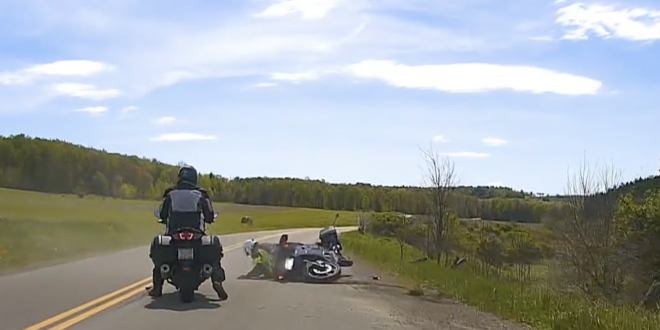
It was while on a group ride last month on some backroads in Pennsylvania and New York that a rider went down in a curve. The mishap was captured on video, which provides a hook for a fresh “Safe Riding” column addressing why it likely happened.
Before reading on, check out the video; first at normal speed and then in slow motion…
Video/photo courtesy of Wayne Sikorski
—
I was leading the lunch ride through winding country roads on what was a gorgeous day, enjoying a 45-mile ride from Corning, NY to Wellsboro, PA. Garmin GPS chose the route for us. There were eight riders on this ride, most of whom I had ridden with before. All are experienced riders. We completed about two-thirds of the one-way trip on a scenic, casually winding road in the small township of Knoxville, PA. The posted speed was 45 miles per hour.
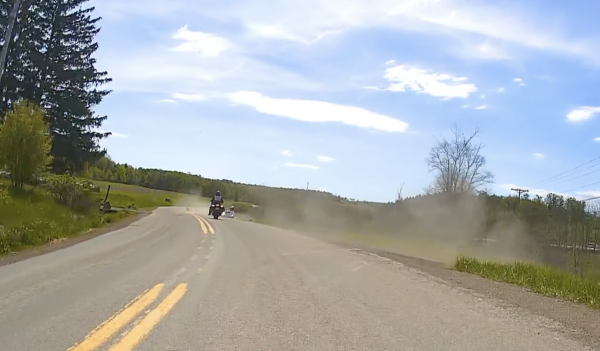
Just after a straight section of road, there was a left-hand sweeper at an intersection with a dirt road. As the rider behind me and I exited the turn, our comms chattered as others were excitedly reporting that a rider had lost control – there was a man down.
—
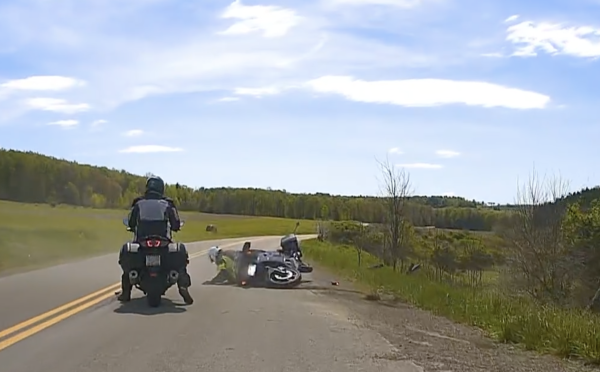
We stopped and U-turned back to the crash scene as quick as we could. Upon arriving, we helped assess the rider’s condition. He was fine but bruised from the fall and a bit shaken up.
The rider stated that he was fiddling with his GPS prior to the turn. He hit the soft shoulder and went into the grass before hitting a rut and then going down, as seen in the video.
Another rider, a retired police officer, and I walked the curve to follow the rider’s path of travel to get a feel of what might have happened.
The video came from another bike’s dashcam and later in the day the video was downloaded and sent to me. I’ve had time to review it and assess what may have happened.
First thing, this 70-plus rider was uninjured, except for some bumps and bruises he would feel later. We attributed this to the fact he was fully outfitted in good riding gear. His motorcycle sustained some scratches and the bags came off, but he was able to ride it home the next day.
I reviewed the saved GPS data from the ride that evening. It showed our approach speed to the curve was only a tad over the posted limit and that I slowed to 40 miles per hour entering the curve. There was nothing excessive or dangerous for the conditions.
The fallen rider’s assessment is no doubt correct. He was distracted by his GPS prior to entering the turn and didn’t refocus his attention until just before or as he hit the sand in the turn.
—
Consider this… If your speed is 40 mph, you are moving about 60 feet per second. That’s a lot of forward movement with no eyes on the road ahead.
There is also a likelihood he had a bit of target fixation on the sand in the soft shoulder when he first looked up. Considering “where you look is where you go,” target fixation might have added to drifting off the roadway.
Once in the sand, the rider could not make any abrupt steering changes due to the limited traction. Once the rider was in the grass, the bike was headed to go over the embankment to his right until it hit the rut. This forced the back end of the bike to spin around back onto the road.
Being momentarily distracted is not an uncommon situation for all riders and can lead to very undesirable outcomes.
The day before our group ride I was behind a different group of riders, and the last rider became distracted looking left and right at scenery while trying to keep up with the group he was with. At one moment he was gazing to the right at scenery, and the bike began drifting in that direction and exited the asphalt onto the soft shoulder. Fortunately, this happened on a straight stretch of road and he was eventually able to recover.
My advice is minimize your distractions and improve your situational awareness. Risk can be reduced by avoiding being distracted to improve perception, so that you know what lies ahead.
And older, seasoned riders need to maintain good focus ahead because their reaction times are slower than they were when they were younger.